




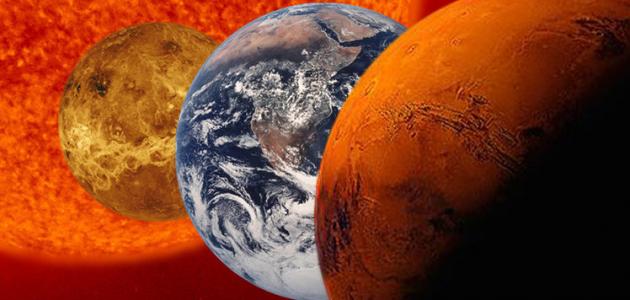
Venus: Earth's Sizzling Sister - Exploring the Hottest Planet
Let's dive into the scorching world of Venus. As the second planet from the sun, Venus is often called Earth's sister due to their similar size and density. But don't let the familial nickname fool you – Venus is a world of extremes, with a toxic atmosphere and surface temperatures hot enough to melt lead!
Overview of Venus
Venus is the sixth-largest planet in our solar system. Its mass is approximately 4.867 × 10^24 kg, and its volume is about 928,415 million cubic kilometers. The surface area of Venus is around 460,234,317 square kilometers, with a density of about 5.243 grams per cubic centimeter. The acceleration due to gravity on the planet's surface is 8.87 m/s². Venus is about 108 million kilometers from the Sun.
Due to its position closer to the Sun than Earth, Venus can only be seen during sunrise or sunset. When visible, it is a brilliant and beautiful sight, often referred to as the Morning Star or Evening Star. This has given Venus a significant role in mythology, art, and astrology across various cultures.
Venus's Atmosphere and Climate
The atmosphere of Venus is primarily composed of carbon dioxide, with dense clouds that make it difficult to see the surface without advanced radar systems. These clouds contain high levels of sulfuric acid. The atmospheric pressure on Venus is about 92 times greater than that on Earth, equivalent to the pressure at a depth of 900 meters in Earth's oceans.
Venus has extremely strong winds, reaching speeds of over 320 kilometers per hour. These winds help to distribute heat evenly across the planet, resulting in relatively consistent temperatures between day and night. The surface temperature of Venus ranges from 438 to 480 degrees Celsius, making it the hottest planet in our solar system.
Magnetic Field of Venus
Venus rotates very slowly, resulting in a weak magnetic field compared to Earth's. Despite the similarities in size and iron core composition between Venus and Earth, the slow rotation of Venus results in a significantly weaker magnetic field.
Structure and Composition of Venus
From space, Venus appears bright white due to the reflection of sunlight off its dense clouds. However, some sunlight penetrates through the atmosphere, giving the planet an orange hue when viewed from its surface. The surface consists of rocks similar to those found on Earth. Venus and Earth are very similar in mass, size, radius, and density, leading Venus to be called Earth's twin.
Despite the similarities, Venus lacks evidence of plate tectonics. This may be due to the solidity of its outer crust, which prevents the filtration of water. The viscosity of Venus's crust is low, preventing cooling, which may explain the absence of an internal magnetic field. The atmosphere of Venus is vastly different from Earth's, consisting mainly of carbon dioxide and sulfuric acid. This atmosphere traps heat, leading to the planet's extreme temperatures.
Orbit of Venus
Venus rotates in the opposite direction to most other planets, from east to west, similar to Uranus. A day on Venus is 243 Earth days, while a year on Venus is about 225 Earth days. The orbit of Venus around the Sun is nearly circular, with very little eccentricity, which results in a lack of seasonal variations.
Terrain of Venus
The surface of Venus is relatively young, dating back 300 to 500 million years. About 90% of the surface is composed of basaltic rocks, mostly distributed across gently sloping plains. Venus has two main highlands: Ishtar Terra in the northern hemisphere and Aphrodite Terra along the equator.
Ishtar Terra is about the size of Australia and contains the highest peak on Venus, Maxwell Montes, which rises 11 kilometers above the planet's surface. Aphrodite Terra is about the size of South America. The surface of Venus has many volcanoes, with some crater diameters exceeding 19 kilometers. There are few impact craters on Venus because most meteoroids burn up in the thick atmosphere before reaching the surface.
History of Venus's Discovery
Venus has been observed since ancient times. Around 3000 BC, the Babylonians recorded Venus as a representation of the goddess Ishtar. The planet has been of interest to various civilizations, including the Greeks, Egyptians, Chinese, and Mesoamericans.
In modern times, Venus continues to be of interest to astronomers due to its proximity to Earth and its brightness. Galileo's discovery of the phases of Venus contributed to a better understanding of the planet. Venus was the first celestial body to be subjected to artificial frequencies in the late 1960s. Later, the Soviet Union launched Venera 15, the first spacecraft to land on Venus. In 1990, NASA launched the Magellan mission, which mapped 98% of the planet's surface. Currently, the Japanese spacecraft Akatsuki is in orbit around Venus to study its properties.